
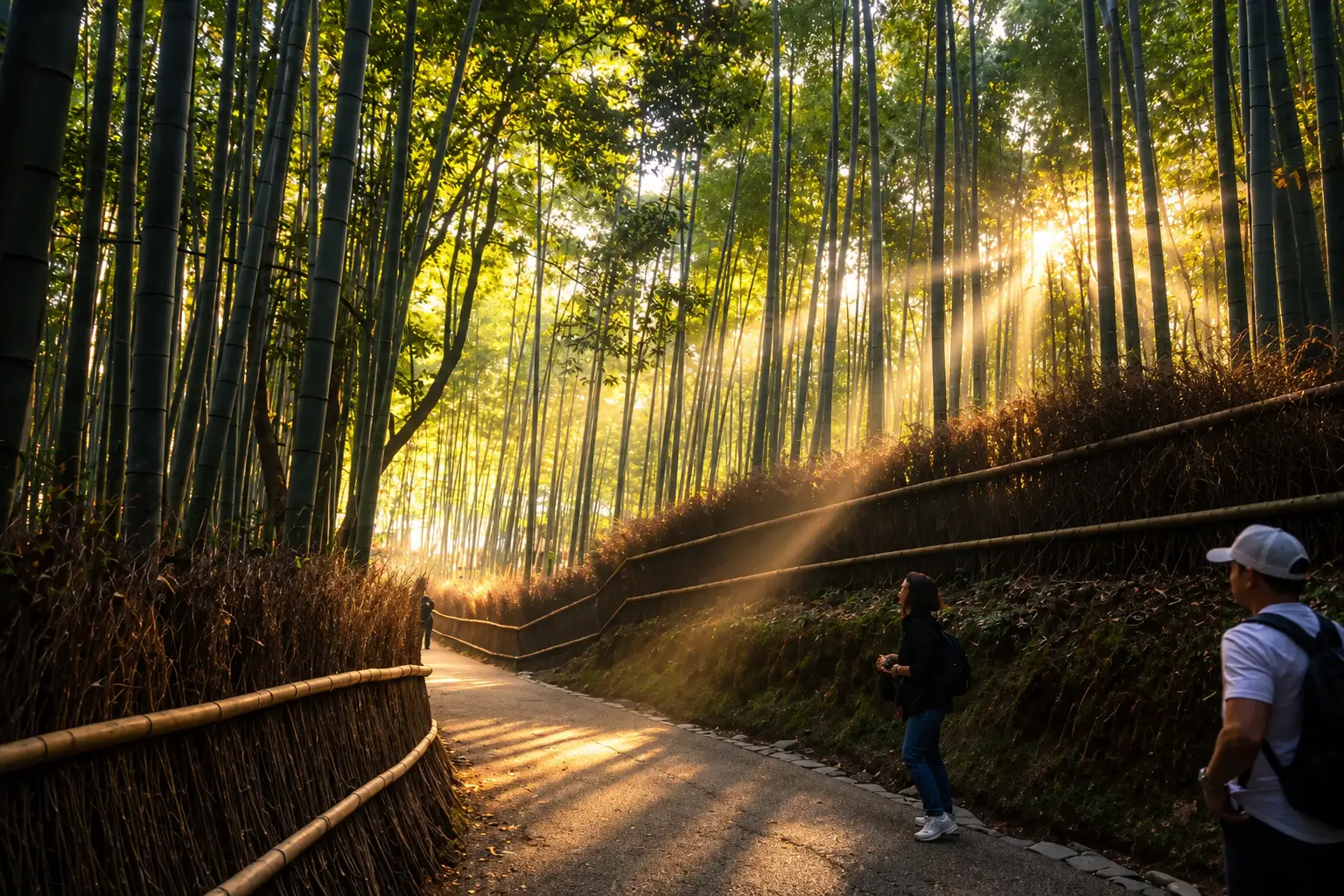
I spent an hour in Arashiyama Bamboo Forest at dawn last week
At 5 am, my phone burst into a bright, synthetic melody, cheerful as a children’s toy.
I’d already been in Japan for more than a week and was staying in Kyoto, in a business hotel at Nijo-jo-mae, opposite Nijo Castle.
This was an adventure I’d been anticipating for months. Shinrin-yoku — forest bathing — in its birthplace, Japan.
It was also going to be a language adventure. My Wi-Fi had run out, so I would have to get there alone, relying on my patchy Japanese and reading hiragana and katakana on the fly.
I was a kilometre from Nijo Station, where I could catch the JR Sagano Line to Saga-Arashiyama. Then another 12-minute walk to the bamboo forest.
Too easy!

The journey
The moon was still visible in the pink sky.
I walked along Sanjo-dori, past shuttered shopfronts. A barber, pan-ya (bakeries), niku (meat shops — shudder).
An older woman cycled past in a soft blue hat, pedalling vigorously towards work, or wherever the morning was taking her.
I wondered whether this sort of everyday movement might be part of Japan’s health story. Could the gentle cycling, miso soup, green tea and sense of purpose in later life have something to do with the country’s comparatively low rates of multiple sclerosis?

A question to explore another day.
After twenty minutes of walking, I still couldn’t see any signs for Nijo Station.
Oh.
First obstacle.
Then I spotted a huge konbini. Time to put my Japanese to work.
Sumimasen, Nijo-eki wa dochira desu ka?
Which way is Nijo Station?
There was adefnite spring in my step as I strode the final 150 metres.
Relaxed, I took the steps and found a seat on the platform.
I watched a pink cloud sitting on the distance hills. I thought about Monkey Magic. Then it dawned on me.
There was no Sagano Line at Nijo Station.
Down the steps again.
Sumimasen. Arashiyama ni ikitai n desu ga, dono hōmu desu ka?
Excuse me. I’d like to go to Arashiyama. Which platform?
A volley of machine-gun Japanese was fired at me.
I think the handsome young man noticed my lack of comprehension.
Ah, mo ichido yukuri...onegaishimasu
Wide eyed, he tried again, simplifying everything.
Ah, Sonobe! Four stations only.
Same railway, different name. Saga-Arashiyama was four stops away.
Relief.
Back to my beautiful cloud.

Into the bamboo
When I stepped off the train, the air had the crispness of home in the Southern Highlands.
Tokyo and Nagoya had been unusually hot for October. I was ready for a chill.
Finding the bamboo forest wasn’t entirely straightforward, but I wandered along the quiet streets, passing a poster on a building that made me laugh.
It looked like someone had applied their makeup with black paint.
Good tip, I thought, that’s what I’ll start doing when I can’t find my makeup. Just use black paint.

It was now around 6 am.
I’m here! I stepped over the threshold int the bamboo lane. There were a few people about, but not many. Everywhere felt pleasantly spacious.
Several people in that bluish dawn light seemed to be content creators. Selfie sticks, phones recording video, fuzzy microphones and occasionally another person doing the filming.
But I was carrying a massive old-school DSLR camera. Canon, of course. Three separate lenses from wide to telephoto. I could hardly talk.
Here’s the thing about Arashiyama Bamboo Forest. It isn’t just bamboo. A fork in the path led me to a train. There’s a railway running through the area, with a pedestrian crossing with a mini boom gate, much like the one at home.

Wide paths wound through the bamboo. Flashes of red-painted fences and lanterns appeared between the slender green stems. Then a cemetery.
Charming and peaceful.
The bamboo rises in tall, slender columns, filtering the early light. The paths curve gently between them.
Space, height, light and quiet. The gentle industry of lens changes, matching the white dots on camera body with camera lens, the satisfying quarter turn and click. Composing a shot. The sound of the shutter release.
An hour of shinrin-yoku
Dawn is definitely the time to visit.

The bamboo grove has no formal opening or closing hours, but I’ve heard that crowds are a daily presence. By mid-morning, I imagine the sense of peace would be difficult to find.
I wandered, enjoying the walk and breathing deeply.
I thought about the simplicity of life here. The familiarity with home. Bamboo and simple solutions for dealing with climate change. Why bamboo isn’t it more widespread as a fencing and building tool given its low cost and sustainability.
And a growing desire for a coffee and something to eat.
Shinrin-yoku is often translated as forest bathing.
It’s not about exercise or reaching a destination. It’s about spending time among trees, noticing the surroundings and allowing yourself to be there.
We know there are health benefits of spending time in nature, like lifting the number of NK cells in the immune system, and reducing blood pressure.
The term shinrin-yoku, or forest bathing, was introduced by Japan’s Forestry Agency in 1982. At the time, Japan was confronting the human cost of its extraordinary economic growth. Long working hours and relentless corporate expectations had given rise to a chilling new word: karoshi (過労死), meaning death from overwork.
Doctors had begun documenting fatal heart attacks and strokes associated with excessive workloads, and the issue was gaining public attention. Against this backdrop, forest bathing offered something refreshingly simple: time away from work, immersed in nature, with permission to slow down.
Researchers including Dr Qing Li and Professor Yoshifumi Miyazaki subsequently investigated its health benefits, finding evidence of reduced stress, improved relaxation and changes in immune function.
More than physical and immune health
Rsearchers studied 280 healthy young men across 24 forests in Japan, comparing approximately 15 minutes of forest walking and 15 minutes of forest viewing with equivalent activities in urban settings.
But it’s more than physical benefits, The experience of being in a forest is enlivening. It lifts you and stimulates you. It makes you pay attention to the moment.
Spiritual roots
The spiritual roots of shinrin-yoku reach deep into Japanese Shinto and Buddhist traditions. In Shinto, forests, ancient trees and mountains are sacred places where kami — divine spirits or presences — may dwell.
Buddhism, particularly Zen, brings an emphasis on mindfulness, impermanence and the interconnectedness of all life. Even the Japanese character for forest, 森 (mori), is formed from three tree characters (木), creating an image of trees gathered together.
Its deeper philosophy draws on centuries of reverence for nature: the understanding that we are not separate from the natural world, but part of it. If only world leaders, billionaires, policy makers, and people with influence could understand this. We need nature. And nature needs us.
We are not separate from the natural world, but part of it.
For me, this was an hour of quiet attention. To the bamboo, the air, the light. To my own thoughts. And the whir of my shutter, and the click of connection.
Around 7 am, I felt a shift. An influx of tourists was arriving. Voices got louder. The sunlight was stronger, becoming harsh on our faces.
Time to go, I thought, and keep the good feeling.
Coffee and the journey home
I wandered the kilometre or so back towards the station, feeling slightly lost but perfectly safe.
Then I found a coffee shop. Usually the coffee shops don’t open until the sensible hour of 11am. But I found an exception.

| my photo
Another chance to practise Japanese.
Ohayou gozaimasu!
Good morning.
An aproned man behind the counter joked that he wasn’t the barista. He went to fetch his wife.
She appeared and after more convivials, I asked:
Tōnyū arimasu ka?
Do you have soy milk?
Hai!
Yes!
And then Shashin-o totte mo iss desu ka?
Is it okay if I take a photo?
Yes, yes please do.
She made me an excellent coffee. So if you are ever in Arashiyama, go at daw, and buy a coffee afterwards from this kind couple on the way back to the train station.
What a perfect morning.
Then it was back on the train, followed by the subway — chikatetsu, a word that sounds rather like the noise it makes — to Nijo-jo-mae.
Back to the castle.
I skipped the kilometre walk through the tunnel this time and arrived at the hotel around 8 am.
Sweet.
Breakfast time with my family, who were just getting out of bed.
The pleasure of a call to adventure
Did an hour of forest bathing help my MS? I can’t say. But it made me feel more alive.
And that has to count for something.
We’re more than bodies and brains. We have emotions, spirit, curiosity.

We all have little calls to adventure.
Living well with MS means making room for these things, too.
After all, life isn’t just about keeping ourselves well. It’s about having something worth getting up for.
Remember, the most pear-shaped adventures make the best stories.
What’s one of your calls to adventure?
Sources and References:
- Park, B.J. et al. (2010). The physiological effects of Shinrin-yoku: evidence from field experiments in 24 forests across Japan. Environmental Health and Preventive Medicine, 15, 18–26. Research examining cortisol, blood pressure, heart rate and autonomic nervous system activity. Also documents the introduction of shinrin-yoku in Japan in 1982.
- Li, Q. et al. (2007). Forest bathing enhances human natural killer activity and expression of anti-cancer proteins. International Journal of Immunopathology and Pharmacology, 20, 3–8. A small Japanese study investigating changes in immune cell activity following forest bathing.
- Li, Q. et al. (2008). A forest bathing trip increases human natural killer activity and expression of anti-cancer proteins in female subjects. Journal of Biological Regulators and Homeostatic Agents, 22, 45–55. Investigates immune responses and stress hormones following a three-day forest visit.
- Li, Q. et al. (2006). Phytoncides (wood essential oils) induce human natural killer cell activity. Immunopharmacology and Immunotoxicology, 28, 319–333. Laboratory research exploring the effects of aromatic compounds released by trees on immune cells.
- Park, B.J. et al. (2007). Physiological effects of Shinrin-yoku using salivary cortisol and cerebral activity as indicators. Journal of Physiological Anthropology. An early experimental study investigating relaxation responses in forest environments.

